
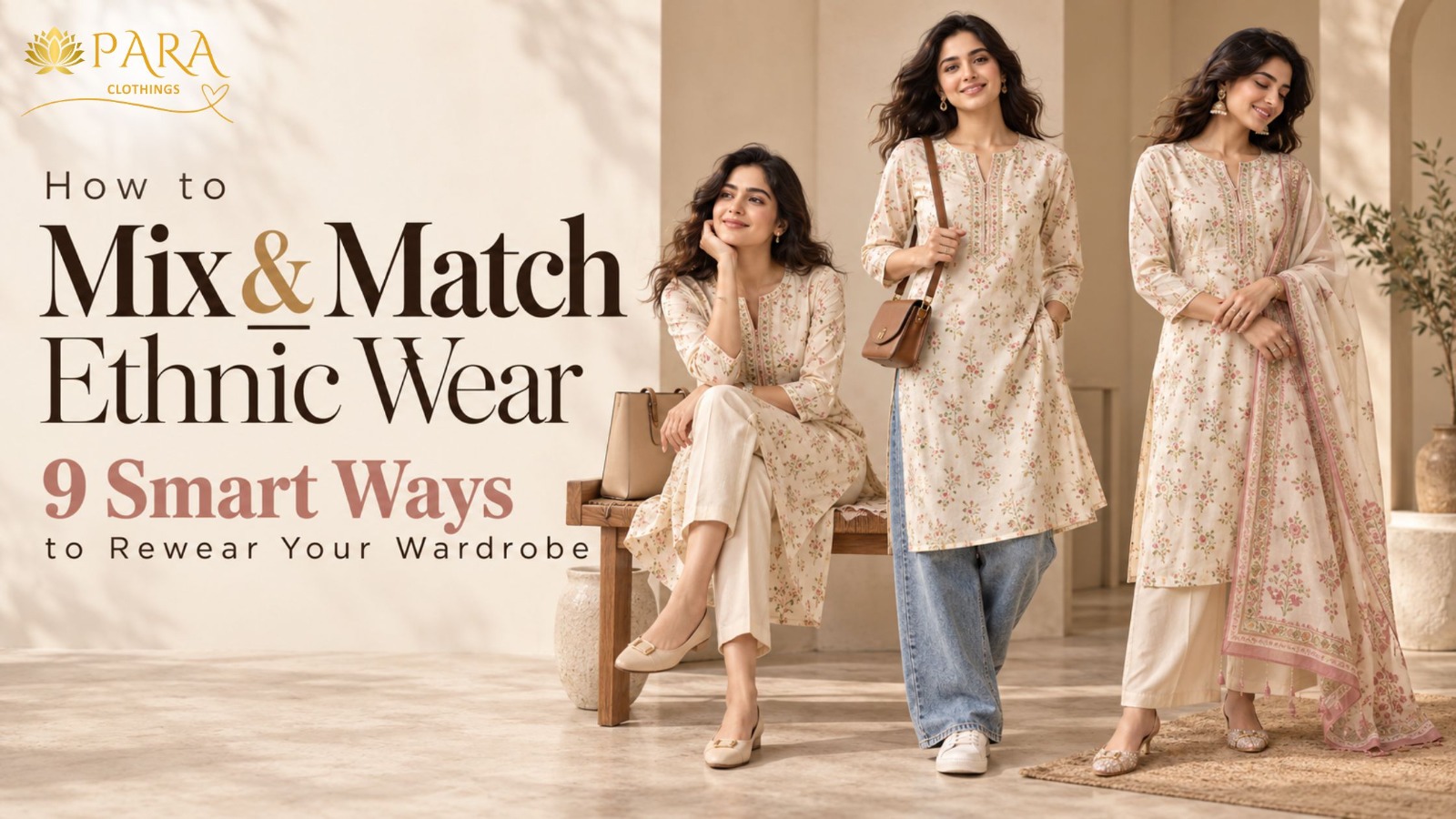
A wardrobe feels bigger when the pieces talk to each other
There is a familiar moment in front of every wardrobe: plenty of clothes, but somehow nothing feels new. The solution is not always another outfit. Often, it is a better way of seeing the pieces you already own.
Ethnic wear is especially good at this because a kurta, a coordinated set, a dupatta, a pair of straight pants or even one statement layer can move between very different looks. A polished office outfit can become a brunch look with a change of bottoms and accessories. A festive suit set can be softened for a smaller family gathering. A co-ord can be split and worn as separates instead of only as a complete set.
PARA Clothings already builds much of its assortment around versatile kurtas, suit sets and co-ords. The current catalogue includes hundreds of kurtas, a large suit-set range and contemporary co-ords, which makes mix-and-match styling a natural way to get more value from the wardrobe rather than treating every garment as a one-occasion outfit.
Explore: PARA Kurtas | Suit Sets | New Arrivals
1. Start with one “anchor” kurta
Choose one kurta as the visual centre of the outfit, then build everything else around it. If the kurta carries print, embroidery or a distinctive neckline, keep the bottoms and accessories calmer. If the kurta is simple, you have more freedom to add texture, jewellery or a stronger outer layer.
A useful wardrobe anchor is not necessarily the most dramatic piece. It is the one you can imagine wearing in three or four different situations. For example: straight pants and flats for work, denims and minimal jewellery for a casual day, or a coordinated dupatta and dressier footwear for a family occasion.
2. Split a co-ord set into separates
A co-ord set gives you an instant finished look, but its real wardrobe value begins when you stop treating the top and bottom as inseparable. Pair the top with solid trousers, denims or a contrasting neutral. Then use the bottom with a simple kurta or clean top that already exists in your wardrobe.
PARA’s co-ord product descriptions themselves emphasise versatility and wearing pieces with wardrobe favourites. That makes co-ords especially useful for women who want polished outfits without owning a completely different look for every plan.
See a current example: Aarika Royale Women’s Co-ord Set
3. Create a three-bottom rotation
Instead of buying a different bottom for every kurta, build a small rotation that works across multiple pieces. Three useful categories are: a clean straight pant, a relaxed or wider silhouette, and one everyday casual option such as denim where the kurta styling supports it.
The idea is not to force every kurta into every combination. It is to reduce the number of pieces that sit unused simply because their original matching bottom is unavailable, uncomfortable or too dressy for the day.
4. Use colour repetition instead of exact matching
An outfit can look coordinated without every element being the same colour. Pick one secondary shade from the print, border or embroidery and repeat it once—through the bottom, footwear, bag or jewellery. This creates visual connection without making the look feel overly matched.
For a quieter result, work with neighbouring neutrals: ivory with beige, chocolate with tan, charcoal with black, or muted pink with warm taupe. PARA’s own palette of warm neutrals and rose-toned accents offers a useful reference for this understated approach.
5. Change the mood with the dupatta
A dupatta is one of the fastest ways to change the character of a suit or kurta look. A lighter, simpler dupatta can make an outfit feel easier for daytime; a richer texture or more detailed drape can move the same base toward a festive setting.
If your suit set includes a distinctive dupatta, consider pairing it with a simpler kurta from another look—provided the colours and proportions feel intentional. This is one of the easiest ways to create a new visual story without buying an entirely new set.
6. Re-style a suit set for smaller occasions
Suit sets are often saved for events because the complete combination feels dressier. To make one work for a smaller gathering, remove one high-impact element rather than adding more. Keep the kurta and bottom but skip the statement dupatta. Choose simpler jewellery. Swap embellished footwear for clean flats or sandals.
PARA currently carries a broad suit-set range designed across festive, family, office and everyday contexts, so the category already lends itself to this kind of controlled dressing-up and dressing-down.
Browse: PARA Suit Sets
7. Let accessories change the occasion
Think of accessories as the final 20% of the outfit rather than the whole styling strategy. The same kurta can feel professional with a structured bag, small earrings and flats; relaxed with an easy tote and minimal jewellery; or festive with a statement earring, clutch and dressier footwear.
This is also where restraint helps. When the garment itself has strong print or embroidery, one focal accessory is usually enough. When the garment is quieter, accessories can carry more of the personality.
8. Build looks in “outfit formulas”
Instead of reinventing your styling every morning, save a few reliable formulas. They reduce decision fatigue and make it easier to see what your wardrobe is missing before you buy anything new.
| Formula | Best for | Easy switch |
| Printed kurta + solid straight pants + flats | Work / everyday | Add earrings + dressier footwear for dinner |
| Co-ord top + denims + minimal jewellery | Brunch / casual outing | Return to matching bottoms for a polished set |
| Suit kurta + simple bottoms + no dupatta | Family lunch / small gathering | Add original dupatta + statement earrings for festive wear |
| Simple kurta + contrasting dupatta + sandals | Cultural / semi-festive | Switch to tote + minimal jewellery for daytime |
| Co-ord bottoms + solid kurta/top | Travel / casual | Add structured bag and cleaner footwear for work |
9. Buy the next piece for at least three outfits
Before adding a new kurta, suit set or co-ord, try the three-outfit test: can you name three realistic ways you would wear it with pieces already in your wardrobe? If yes, it is more likely to become part of your regular rotation instead of waiting for one very specific occasion.
This does not mean every purchase must be minimal or practical. Fashion should still be expressive. The point is simply to recognise the difference between a deliberate statement piece and an item you are buying because it looks good in isolation.
A simple mix-and-match checklist
- Choose one anchor piece first.
- Balance a detailed garment with quieter supporting pieces.
- Try the co-ord top and bottom separately.
- Keep a small rotation of versatile bottoms.
- Repeat a colour rather than matching everything exactly.
- Use the dupatta to change the level of dressiness.
- Change accessories before changing the entire outfit.
- Save 3–5 outfit formulas that reliably work for you.
- Before buying, imagine at least three real combinations.
Rewearing is also a better use of what you own
Mix-and-match styling is primarily about creativity and convenience, but there is a wider benefit: clothes that remain useful for longer do not need to be replaced as quickly. WRAP has identified extending clothing life as an important opportunity to reduce clothing-related resource use and waste, while UNEP has highlighted the need for fashion systems that move away from constant newness and disposability toward reuse and circularity.
Further reading: WRAP – Design for extending clothing life | UNEP – Transforming the Textile Industry
Take care of the pieces you want to rewear
A versatile wardrobe only works when the garments stay wearable. Always follow the care label attached to the specific item rather than assuming all kurtas, suit sets or co-ords can be washed and ironed in the same way. GINETEX explains that textile care labels communicate the maximum appropriate treatment for washing, bleaching, drying, ironing and professional care.
Care reference: GINETEX textile care guidance
Final thoughts
A better ethnic wardrobe is not necessarily a larger one. It is a wardrobe where a kurta can become three outfits, a co-ord can become separates, a festive suit can be softened for daytime, and accessories can change the mood without changing the entire look.
The next time an outfit feels too familiar, do not immediately ask, ‘What should I buy?’ Ask, ‘What have I not tried with this yet?’ That question can make the same wardrobe feel surprisingly new.
Explore PARA Clothings
Discover current kurtas, suit sets, sarees and new arrivals from PARA Clothings.
Frequently Asked Questions
How can I mix and match ethnic wear without making it look mismatched?
Start with one anchor piece and repeat one colour, texture or visual detail elsewhere in the outfit. Keep at least one supporting piece neutral so the look feels intentional rather than busy.
Can a co-ord set be worn separately?
Often, yes. If the cut and design work independently, the top can be paired with other bottoms and the bottom with a simpler kurta or top. Always judge the actual garment rather than assuming every set will separate equally well.
How can I make a festive suit set look more casual?
Reduce one or two high-impact elements. Wear the kurta and bottoms without the statement dupatta, choose simpler jewellery, and switch to understated footwear or a daytime bag.
What colours are easiest to mix with ethnic wear?
Warm neutrals such as ivory, beige, tan, chocolate, charcoal and black are flexible starting points. The best neutral depends on the colours already present in your wardrobe and the garment you are styling.
How do I get more wear from a kurta?
Try changing the bottom silhouette, layering with a different dupatta, pairing it with denim where appropriate, and rotating accessories. Photograph combinations you like so you can repeat them easily.
Pingback: How to Care for Ethnic Wear: 10 Tips to Keep Kurtas, Suit Sets & Sarees Looking New – Paraclothings